Sept. 16, 2026

Eastside Market Update: More Homes to Look At — Financing Still the Filter

More Eastside homes to look at than a year ago — but rates are still the main hurdle for a lot of buyers.

August Eastside single-family snapshot

(NWMLS King Breakouts, EastSide residential)

  • Actives: 1,868 (+45.6% year over year)
  • Months of supply: 4.24
  • August median sold: $1,445,721 (−6.0% year over year)
  • Closed: 441 (−7.7% YoY)
  • Pending: 536 (+4.1% YoY)

This week’s financing print

Freddie Mac’s 30-year average was 6.76% for the week ending September 10 (up from 6.71%). That’s a national average — not a quote from Homes Northwest, and not a rate we can lock for you.

If you’re buying

Use the extra selection. Pressure-test cash to close before you fall in love with a house. Start or update your Eastside search at eastsideluxuryliving.com or homesnwre.com.

If you’re selling

Price to today’s comps, not last spring’s. Curious what your home may be worth? checkmyvalue.net

Questions on your street or price point? Call or text Paul & Christine Nelson at 206-261-7355.

— Paul & Christine Nelson, Homes Northwest Real Estate · Bellevue · Selling Eastside since 1992

Sources

NWMLS King Breakouts August 2026 (EastSide residential); Freddie Mac PMMS via FRED (week ending September 10, 2026).

Posted in Market Updates
Sept. 6, 2026

NWMLS First Look, Explained for Eastside Buyers and Sellers

On August 31, 2026, Northwest MLS announced a new optional listing status called First Look. It became available September 4, 2026.

This is not a private “coming soon” club inside one brokerage. NWMLS’s own rule is blunt: every First Look listing must be submitted to the MLS and made available to all 30,000+ member brokers. No shadow inventory.

Here is what actually changes for Eastside families.

The two numbers that matter

60 days off market

A property generally must have been off the market for at least 60 days before it can use First Look. Fresh flips from Active to “pre-market theater” are not the point.

21-day window

Once in First Look, the home can stay there for up to 21 days, then it converts to Active (sooner if the seller and listing broker move it). Sellers get preparation time. The clock is not endless.

What sellers control

During First Look, the seller (with their listing broker) can decide:

What buyers must change

If your search only shows Active listings on a public site, you can miss First Look homes that brokers already see.

  • First Look is in the MLS for every member broker from day one
  • It may or may not show on IDX / portal feeds, depending on the seller’s choice
  • Showings may or may not be open yet

So the fix is working with a broker who searches the full NWMLS picture for Bellevue, Sammamish, Issaquah, Kirkland, Redmond, Mercer Island, and the rest of the Eastside.

Quick FAQ

One next step (buyers)

Stop relying on Active-only browsing. Set up a real Eastside search with us so First Look homes land in your alerts.

Start your search →

Read our Eastside market update

Paul and Christine Nelson
Homes Northwest Real Estate
206-261-7355
Selling Eastside homes since 1992

Is First Look off-MLS? No. Universal broker access is the non-negotiable part.

Can a seller skip showings during First Look? Yes. Optional showings are a seller choice.

Will I see every First Look home on every website? Not necessarily. IDX display is a seller choice during First Look. Your broker still can.

Does First Look time show as public days on market later? Public Active clocks are handled differently from First Look time. Brokers still have the internal history.

  • Showings: allow them now, or wait until Active
  • IDX / website feeds: publish to IDX sites, or keep public marketing more targeted while brokers still see the listing in NWMLS

Listing activity during First Look stays in the internal NWMLS database for brokers and their clients. Public Active clocks are handled differently from First Look time.

Sellers: First Look is a prep-and-position tool, not a reason to skip pricing strategy. If you want the number for your address before you choose list, cash, fix-and-sell, or wait, start at https://checkmyvalue.net

Posted in Market Updates
Sept. 6, 2026

Eastside Market Update: September 2026

Rates at a 15-month high. Eastside demand still active. Selection is shrinking.

Early fall on the Eastside: inventory is off the late-July peak, pending sales have firmed, and mortgage rates just printed a 15-month high. More choice than last year’s scramble — but the “max choice” window is closing on schedule.

Eastside snapshot — as of September 2, 2026

  • Rates: 6.91% (15-mo high · +16 bp)
  • Actives: 1,845 (off late-July peak)
  • Pending: 130 (3rd weekly gain)
  • MOI: 3.26 (upper balanced)
  • 30-day median sold: about $1.56M

What changed

Active listings peaked near 1,923 in late July and have now fallen to 1,845 — the sharpest weekly drop of the year. Pending climbed three weeks in a row (110 → 117 → 130) even as rates jumped to 6.91%. Months of inventory pulled back into mid/upper balanced territory.

If you’re buying

Keep a live search on for Bellevue, Sammamish, Issaquah, Redmond, Kirkland, and Mercer Island, and add First Look so you don’t miss pre-Active marketing. Washington down payment assistance programs may help eligible buyers on purchases up to about $1,063,750 (income and program rules apply).

First Look (quick note)

Live in NWMLS since September 4. Eligible homes off-market ≥ 60 days can market up to 21 days before Active. Brokers still see them in the MLS. Active-only auto-emails miss them until First Look is added.

Browse Eastside homes →

Selling this fall? Want a number for your address? https://checkmyvalue.net

Paul and Christine Nelson
Homes Northwest Real Estate
206-261-7355
1400 112th Ave SE Suite 100, Bellevue, WA 98004
Selling Eastside homes since 1992

Posted in Market Updates
June 3, 2022

History Proves Recession Doesn’t Equal a Housing Crisis [INFOGRAPHIC]

History Proves Recession Doesn’t Equal a Housing Crisis [INFOGRAPHIC] | MyKCM

Some Highlights

  • It’s important to understand history proves an economic slowdown does not equal a housing crisis.
  • In 4 of the last 6 recessions, home prices actually appreciated. Home prices only fell twice – minimally in the early 90s and then by nearly 20% during the housing crash in 2008.
  • If you have questions, let’s connect to discuss why today’s housing market is nothing like 2008.
Posted in KCM Blog
June 2, 2022

How Homeownership Impacts You

How Homeownership Impacts You | MyKCM

June is National Homeownership Month, and it’s the perfect time to reflect on how impactful owning a home can truly be. When you purchase a house, it becomes more than just a space you occupy. It’s your stake in the community, an investment, and a place you can put your stamp on.

If you’re thinking about buying a home this year, here are some of the benefits you'll experience when you do.

The Emotional Benefits of Homeownership

Because it’s a place that's uniquely yours, owning a home can give you a sense of pride and happiness in several ways.

Your Home Can Reflect Your Tastes and Personality

Investopedia puts it like this:

“One often-cited benefit of homeownership is the knowledge that you own your little corner of the world.

That knowledge can lead to a powerful, emotional connection to the place where you live. But so can the realization that your home will grow with you. Because it’s yours, you have the freedom to make updates to it as your needs and tastes change. As Logan Mohtashami, Lead Analyst for HousingWiresays:

“The psychology is that this is yours and you’re going to make it as good as possible because you’re in for a long time, . . . “

And that can create a greater sense of ownership, pride, and connection with your home and your community.

It Can Enhance Your Neighborhood and Civic Engagement

Homeownership can lead you to get even more involved with your local area. After all, you’re putting your roots down in a location and will want to do what you can to help improve it, much like your home. In a recent report, the National Association of Realtors (NAR) says:

Living in one place for a longer amount of time creates and [sic] obvious sense of community pride, which may lead to more investment in said community.”

The Financial Benefits of Homeownership

When you choose to become a homeowner, you’re making a financial decision as well. That’s because your home is also an investment.

It Can Help You Feel Financially Stable

Homeownership is truly one of the best ways to improve your long-term financial position. Not only will you have a predictable monthly housing expense that can benefit your budget in the short term, but you’ll also gain equity as your home appreciates in value and you make your monthly mortgage payment. As Freddie Mac says:

“Building equity through your monthly principal payments and appreciation is a critical part of homeownership that can help you create financial stability.”

It Can Grow Your Wealth

Because of your growing equity, you can build your net worth as a homeowner. And when you compare the difference in net worth between a renter and a homeowner, it’s clear that owning a home truly offers a great way to build your long-term financial position.

According to the latest data from NAR, the median household net worth of a homeowner is roughly $300,000, while the median net worth of renters is only about $8,000. That means a homeowner’s net worth is nearly 40 times that of a renter.

Bottom Line

Homeownership is truly a way to find greater satisfaction and happiness and to build financial freedom. If National Homeownership Month has you dreaming about purchasing a home, then let’s connect to begin the process today.

Posted in KCM Blog
June 1, 2022

Why Home Loans Today Aren’t What They Were in the Past

Why Home Loans Today Aren’t What They Were in the Past | MyKCM

In today’s housing market, many are beginning to wonder if we’re returning to the riskier lending habits and borrowing options that led to the housing crash 15 years ago. Let’s ease those concerns.

Several times a year, the Mortgage Bankers Association (MBA) releases an index titled the Mortgage Credit Availability Index (MCAI). According to their website:

“The MCAI provides the only standardized quantitative index that is solely focused on mortgage credit. The MCAI is . . . a summary measure which indicates the availability of mortgage credit at a point in time.”

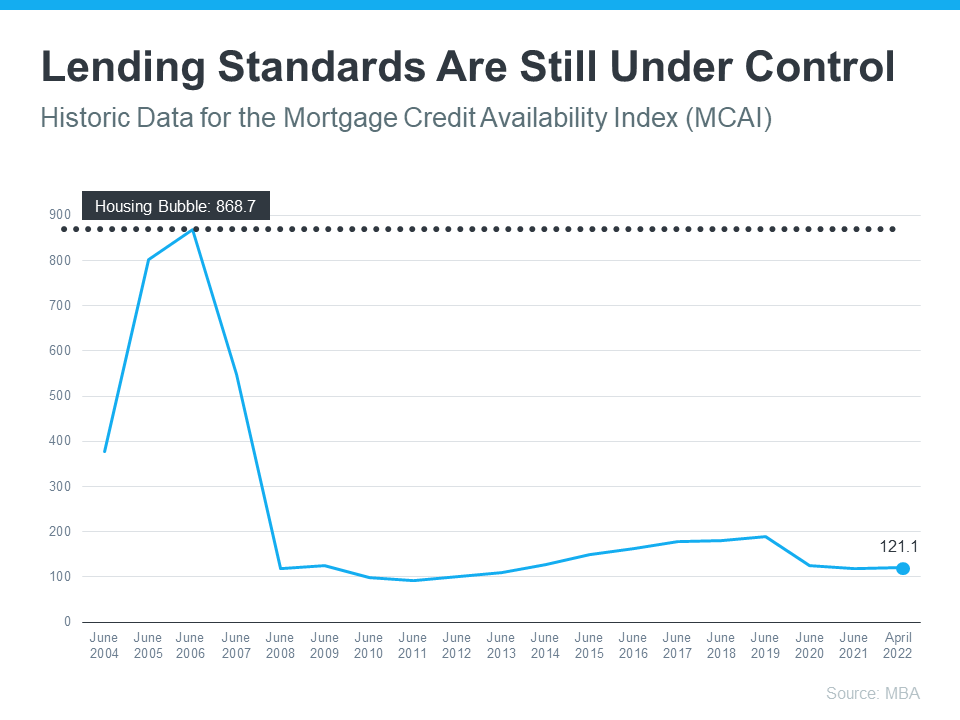
Basically, the index determines how easy it is to get a mortgage. The higher the index, the more available mortgage credit becomes. Here’s a graph of the MCAI dating back to 2004, when the data first became available:

Why Home Loans Today Aren’t What They Were in the Past | MyKCMAs the graph shows, the index stood at about 400 in 2004. Mortgage credit became more available as the housing market heated up, and then the index passed 850 in 2006. When the real estate market crashed, so did the MCAI as mortgage money became almost impossible to secure. Thankfully, lending standards have eased somewhat since then, but the index is still low. In April, the index was at 121, which is about one-seventh of what it was in 2006.

Why Did the Index Get out of Control During the Housing Bubble?

The main reason was the availability of loans with extremely weak lending standards. To keep up with demand in 2006, many mortgage lenders offered loans that put little emphasis on the eligibility of the borrower. Lenders were approving loans without always going through a verification process to confirm if the borrower would likely be able to repay the loan.

An example of the relaxed lending standards leading up to the housing crash is the FICO® credit score associated with a loan. What’s a FICO® score? The website myFICO explains:

“A credit score tells lenders about your creditworthiness (how likely you are to pay back a loan based on your credit history). It is calculated using the information in your credit reports. FICO® Scores are the standard for credit scores—used by 90% of top lenders.”

During the housing boom, many mortgages were written for borrowers with a FICO score under 620. While there are still some loan programs that allow for a 620 score, today’s lending standards are much tighter. Lending institutions overall are much more attentive about measuring risk when approving loans. According to the latest Household Debt and Credit Report from the New York Federal Reservethe median credit score on all mortgage loans originated in the first quarter of 2022 was 776.

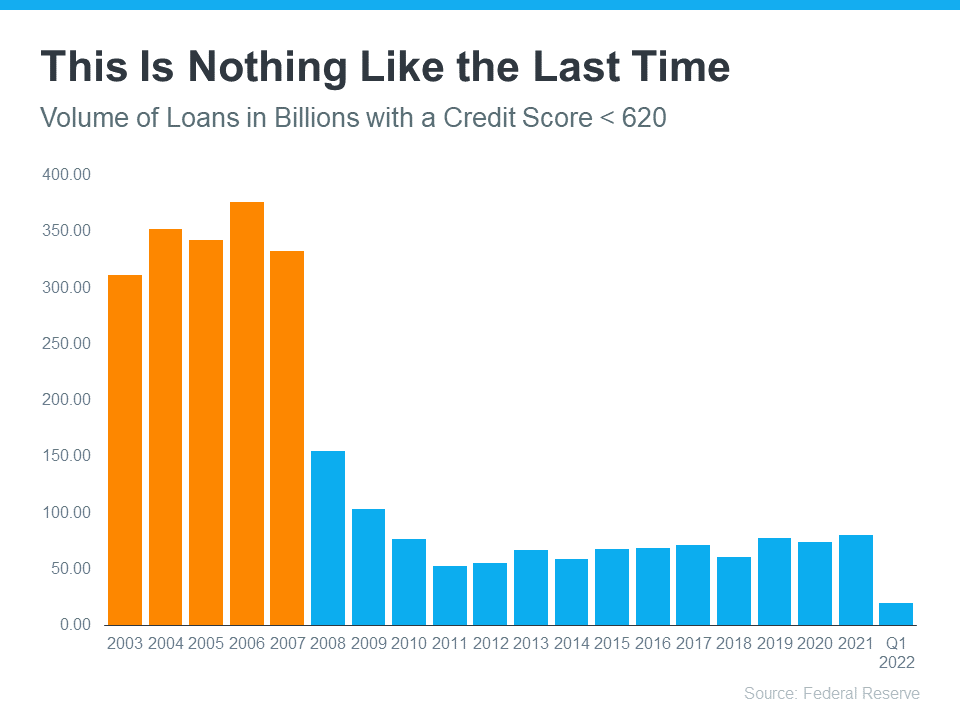
The graph below shows the billions of dollars in mortgage money given annually to borrowers with a credit score under 620.

Why Home Loans Today Aren’t What They Were in the Past | MyKCMIn 2006, buyers with a score under 620 received $376 billion dollars in loans. In 2021, that number was only $80 billion, and it’s only $20 billion in the first quarter of 2022.

Bottom Line

In 2006, lending standards were much more relaxed with little evaluation done to measure a borrower’s potential to repay their loan. Today, standards are tighter, and the risk is reduced for both lenders and borrowers. These are two very different housing markets, and today is nothing like the last time.

Posted in KCM Blog
May 31, 2022

What Does the Rest of the Year Hold for the Housing Market?

What Does the Rest of the Year Hold for the Housing Market? | MyKCM

If you’re thinking of buying or selling a house, you’re at an exciting decision point. And anytime you make a big decision like that, one thing you should always consider is timing. So, what does the rest of the year hold for the housing market? Here’s what experts have to say.

The Number of Homes Available for Sale Is Likely To Grow

There are early signs housing inventory is starting to grow and experts say that should continue in the months ahead. According to Danielle Hale, Chief Economist at realtor.com:

“The gap between this year’s homes for sale and last year’s is one-fifth the size that it was at the beginning of the year. The catch up is likely to continue, . . . This growth will mean more options for shoppers than they’ve had in a while, even though inventory continues to lag pre-pandemic normal.”

  • As a buyer, having more options is welcome news. Just remember, housing supply is still low, so be ready to act fast and put in your best offer up front.
  • As a seller, your house may soon face more competition when other sellers list their homes. But the good news is, if you’re also buying your next home, having more options to choose from should make that move-up process easier.

Mortgage Rates Will Likely Continue To Respond to Inflationary Pressures

Experts also agree inflation should continue to drive up mortgage rates, albeit more moderately. Odeta Kushi, Deputy Chief Economist at First Americansays:

“… ongoing inflationary pressure remains likely to push mortgage rates even higher in the months to come.”  

  • As a buyer, work with trusted real estate professionals, including your lender, so you can learn how rising mortgage rate environments impact your purchasing power. It may make sense to buy now before it costs more to do so, if you’re ready.
  • As a seller, rising mortgage rates are motivating some homeowners to make a move up sooner rather than later. If you’re planning to buy your next home, talk to a trusted real estate advisor to decide how to time your move.

Home Prices Are Projected To Continue To Climb

Home prices are forecast to keep appreciating because there are still fewer homes for sale than there are buyers in the market. That said, experts agree the pace of that appreciation should moderate – but home prices won’t fall. Lawrence Yun, Chief Economist at the National Association of Realtors (NAR), explains:

“Prices throughout the country have surged for the better part of two years, including in the first quarter of 2022. . . Given the extremely low inventory, we're unlikely to see price declines, but appreciation should slow in the coming months.” 

  • As a buyer, continued home price appreciation means it’ll cost you more to buy the longer you wait. But it also gives you peace of mind that, once you do buy a home, it will likely grow in value. That makes it historically a good investment and a strong hedge against inflation.
  • As a seller, price appreciation is great news for the value of your home. Again, lean on a professional to strike the right balance of the best conditions possible for both selling your house and buying your next one.

Bottom Line

Whether you’re a homebuyer or seller, you need to know what’s happening in the housing market, so you can make the most informed decision possible. Let’s connect to discuss your goals and what lies ahead, so you can pick your best time to make a move.

Posted in KCM Blog
May 30, 2022

Remember and Honor Those Who Gave All

Remember and Honor Those Who Gave All | MyKCM

We remember and honor those who gave all.

Posted in KCM Blog
May 27, 2022

Bright Days Are Ahead When You Move Up This Summer [INFOGRAPHIC]

Bright Days Are Ahead When You Move Up This Summer INFOGRAPHIC] | MyKCM

Some Highlights

  • Warmer weather and longer days mean summer is almost here. Celebrate by upgrading to the home of your dreams so you can enjoy all the season has to offer.
  • When you list your house, you can capitalize on today’s sellers’ market to fuel your upgrade. Then, you can move to a home with the features you want, like space to entertain or rooms for work and play.
  • If you’re ready to upgrade to a home that matches your changing needs, let’s connect.
Posted in KCM Blog
May 26, 2022

Why Summer Is a Great Time To Buy a Vacation Home

Why Summer Is a Great Time To Buy a Vacation Home | MyKCM

You may be someone who looks forward to summer each year because it gives you an opportunity to rest, unwind, and enjoy more quality time with your loved ones. Now that summer is just around the corner, it’s worthwhile to start thinking about your plans and where you want to spend your vacations this year. Here are a few reasons a vacation home could be right for you.

Why You May Want To Consider a Vacation Home Today

Over the past two years, a lot has changed. You may be one of many people who now work from home and have added flexibility in where you live. You may also be someone who delayed trips for personal or health reasons. If either is true for you, there could be a unique opportunity to use the flexibility that comes with remote work or the money saved while not traveling to invest in your future by buying a vacation home.

Bankrate explains why a second home, or a vacation home, may be something worth considering:

“For those who are able, buying a second home is suddenly more appealing, as remote working became the norm for many professionals during the pandemic. Why not work from the place where you like to vacation — the place where you want to live?

If you don’t work remotely, a vacation home could still be at the top of your wish list if you have a favorite getaway spot that you visit often. It beats staying in a tiny hotel room or worrying about rental rates each time you want to take a trip.”

How a Professional Can Help You Find the Right One

So, if you’re looking for an oasis, you may be able to make it a second home rather than just the destination for a trip. If you could see yourself soaking up the sun in a vacation home, you may want to start your search. Summer is a popular time to buy vacation homes. By beginning the process now, you could get ahead of the competition.

The first step is working with a local real estate advisor who can help you find a home in your desired location. A professional has the knowledge and resources to help you understand the market, what homes are available and at what price points, and more. They can also walk you through all the perks of owning a second home and how it can benefit you.

recent article from the National Association of Realtors (NAR), mentions some of the top reasons buyers today are looking into purchasing a second, or a vacation, home:

“According to Google's data, the top reasons that homeowners cited for purchasing a second home were to diversify their investments, earn money renting, and use as a vacation home.”

If any of the reasons covered here resonate with you, connect with a real estate professional to learn more. They can give you expert advice based on what you need, your goals, and what you’re hoping to get out of your second home.

Bottom Line

Owning a vacation home is an investment in your future and your lifestyle. If this is one of your goals this year, you still have time to buy and enjoy spending the summer in your vacation home. When you’re ready to get started, let’s connect.

Posted in KCM Blog